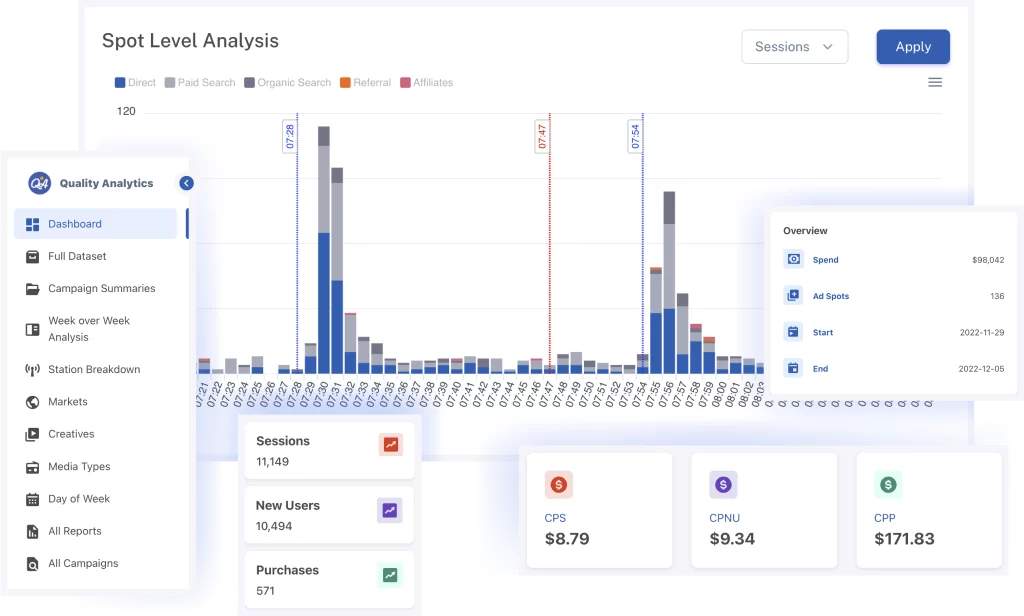
Use this FAQ to understand how linear TV and radio attribution quantifies the impact of broadcast, cable, satellite and radio spots when direct tracking does not exist. We cover how the analysis works, what data we need, which KPIs to track, and how to use the results to optimize stations, dayparts and creative.
What is TV attribution?
TV attribution links scheduled TV airings to time-stamped outcomes (site visits, branded search, calls) to estimate incremental lift. It separates true response from background traffic so you can optimize spend with clearer directional signals.
Note: In a linear TV context, attribution refers to estimating incremental response patterns using time-aligned modeling, not deterministic user-level tracking or proof of causality.
How does linear TV analytics work?
We align each spot’s exact air time with minute-by-minute outcomes and compare against a forecasted baseline to measure lift. This form of TV ad analysis reveals immediate and delayed effects by network, daypart, creative, market, and more.
Which media are supported?
We measure broadcast TV, cable and satellite, national and local, plus national, local and satellite radio, including live reads. All we need is an accurate airing time and market.
Do you measure CTV or on-demand?
Our focus is linear TV and radio. We can support live CTV environments with clear airing timestamps. Pure on-demand environments (e.g., podcasts and streaming libraries) aren’t measurable without ad-level timestamps.
Can you measure radio advertising?
Yes. Local and national broadcast radio, satellite radio and live reads are measured the same way as TV: station logs are matched minute by minute to your GA4 traffic, and local spots are measured against that market's traffic only. Podcasts and on-demand streaming audio can't be measured this way because they have no airing time. More in our radio attribution guide.
What data do you need to get started?
Read-only analytics access (e.g., GA4) and airing logs with timestamps, creative names, network/station, and market (DMA or geo). More detail yields better TV commercial analytics and faster optimization.
Which KPIs are tracked?
Top-of-funnel (sessions, new users) and bottom-of-funnel (leads, purchases, or your primary conversion). We can also track calls and other custom KPIs tied to your business.
How quickly are results updated?
Dashboards refresh daily (typically by early morning Pacific). You’ll see spot-level results the day after air.
How are delayed effects handled?
Lift curves capture both immediate spikes and decaying response over time. We quantify delayed effects without “credit windows” that inflate results.
What is TV campaign tracking?
It’s the ongoing process of measuring spot-level lift and reallocating budget toward the best networks, dayparts, programs, creatives, and markets. TV campaign tracking turns analytics into weekly optimization.
Do you support local and national campaigns?
Yes. We report at the market level for local campaigns and nationally for cable/broadcast buys—both can be compared side-by-side.
Can you measure offline sales and call centers?
Yes. If you can timestamp conversions (e.g., call logs, POS batches) we can connect them to airings for full-funnel TV analysis. For calls specifically, see how to attribute phone calls to TV and radio ads.
How long does onboarding take?
Same-day onboarding is possible once we have read-only analytics access and airing logs (CSV or Excel).
Do you offer a free trial?
Yes. Give us read-only GA4 access and a postlog and we return your first report the next business day, with no contract to sign. We will process up to one month of airings before you decide anything.
How is pricing structured?
Flat monthly pricing by media-spend tier — see plans from $399/mo.
Do you offer training and support?
Yes—live onboarding, ongoing Q&A, and documentation so your team can confidently use linear TV analytics for optimization.
Is there an API or data limits?
API access is available at no additional cost. There’s no hard data cap; larger historical loads simply take longer to process.
Related resources: What is TV Attribution • TV Analytics & Campaign Optimization