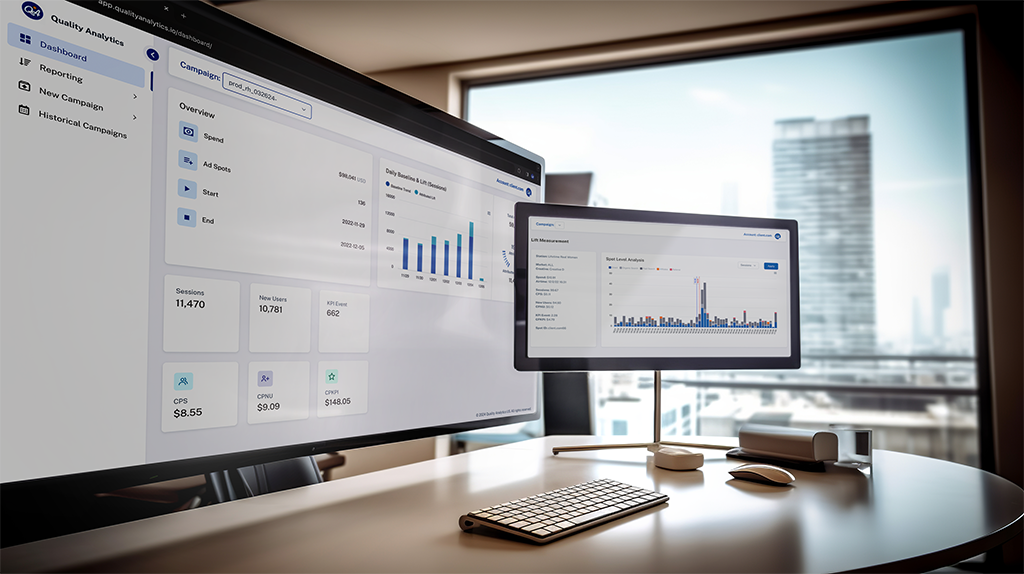
Call centers see the results of TV faster than almost anyone—if you can connect the dots.
TV attribution for call centers helps estimate how much inbound demand is influenced by scheduled TV airings—even when the customer calls a generic 1-800 number from your website instead of the number shown in the commercial. By aligning airing timestamps with time-stamped call logs (and, optionally, web activity), you can quantify directional incremental lift, staff more efficiently, and optimize media toward the stations, dayparts, markets, and creatives that are most likely driving response.
Important: Results are modeled, assumption-based estimates intended for comparative and directional analysis. They are not guarantees of performance and should not be interpreted as definitive proof that any single call was caused by a specific ad.
What “success” can mean for call centers: inbound calls, answered calls, qualified calls, transfers, booked appointments, policy binds, sales, revenue, or any call outcome you can timestamp and report consistently.
The Challenge of Generic 1-800 Numbers
Call centers play a vital role in bridging TV advertisements and customer conversions. Traditionally, a television commercial might feature a dedicated phone number tied to a station, creative, or campaign. When a call comes in on that dedicated number, the association is straightforward.
But in real campaigns, a large share of response is routed differently: customers search the brand, visit the website, and then call the generic phone number listed on the site. That breaks the “unique number per spot” approach and creates a blind spot in measurement.
Example scenario:
- A potential customer sees a TV commercial for an eyeglasses brand.
- Instead of calling the number shown on the ad, they visit the website for more information.
- On the website, they find and call the generic 1-800 number.
The call is captured, but the TV influence is no longer obvious. Without a time-aligned attribution approach, that impact is often undercounted or missed entirely—especially when you’re trying to optimize quickly.
How TV Attribution Helps Call Centers
Modern TV attribution uses timing and patterns to estimate incremental response. For call centers, the key is simple: TV airings occur at known times, and call volume often shows observable movement shortly after air.
- Capture airing logs: exact timestamp, network/station, market/DMA, and creative (when available).
- Align call outcomes: time-stamped call logs (inbound calls, answered calls, qualified calls, transfers, appointments, sales—whatever you consider success).
- Model an expected baseline: estimate what call volume would have looked like absent the airing using recent history, seasonality, day-of-week/hour patterns, and known campaigns.
- Estimate incremental lift: compare observed call outcomes to the modeled baseline immediately after each airing and through any decaying response.
- Roll up performance: aggregate lift by station, daypart, market, and creative to guide staffing and media optimization.
This is especially valuable when the majority of your response is routed through a website number, because the method doesn’t require customers to dial an ad-specific line for you to measure directional impact.
Data Requirements (What We Need)
- Airing logs: timestamp, station/network, market/DMA, creative name or ID.
- Call logs: call timestamp (start time is usually best), plus at least one consistent outcome field (e.g., answered/abandoned, qualified, transfer, sale).
- Optional web signals: GA4 sessions/conversions and/or branded search volume to validate patterns and strengthen the read of campaign movement.
- Optional cost inputs: spot costs or campaign spend so you can view cost-per outcomes alongside lift.
Data quality note: The more accurate your timestamps and market metadata, the more reliable the directional lift estimates will be.
Benefits for Call Centers and Advertisers
1) Quantify how much call volume TV is likely driving
You can estimate how much of your inbound demand is plausibly incremental from TV exposure—even when calls come through a generic website number. This supports clearer ROI conversations and more confident budgeting.
2) Staff smarter based on when TV is most likely to generate demand
If certain networks, markets, or dayparts consistently coincide with higher incremental call lift, you can schedule agents around those windows and reduce missed calls or long hold times during peak response.
3) Optimize media toward placements that are most likely producing outcomes
Instead of optimizing for impressions alone, you can shift spend toward stations, dayparts, markets, and creatives that show stronger directional lift in the metrics you care about (qualified calls, transfers, sales).
4) Strengthen client relationships with transparent, repeatable reporting
For call centers that support advertisers or agencies, better attribution reporting turns the call center into a strategic partner—not just an execution vendor—by linking operations, staffing, and media decisions to measurable outcomes.
Real-World Example: Eyeglasses Brand
Suppose a customer sees a TV ad, visits the website, and then calls the generic 1-800 number. With time-aligned TV attribution in place:
- The system detects a directional increase in call activity relative to a modeled baseline following the airing.
- That incremental lift is summarized back to the airing (and rolled up by station/daypart/market/creative).
- The advertiser gains a clearer picture of which TV placements are most likely contributing to inbound call demand—even without relying on unique phone numbers.
That insight makes it easier to improve media efficiency and to coordinate staffing with the schedule.
Next Steps
If you’re exploring TV attribution for call centers, these resources help you go deeper:
Want to see what this looks like on your data? Book a demo and we’ll walk through the inputs needed (airing logs + call timestamps) and what you can expect from directional lift reporting. Plans start from $399/mo, month-to-month.